Joyful Funerals?
Reading time: 7 minutes
Has Maria Ever Been Happy?
Maria Meinertzhagen was born in Cologne in 1712, moved to the Netherlands and married there in 1735. In the 13 years after that, she produced no fewer than eleven children, six of whom died in those same 13 years, and one was stillborn. One baby born every year, one baby lost every other year. Those deaths sometimes came in quick succession: two of her little sons died in October and December 1743. Maria was usually pregnant when one of the babies died. The six children who died were less than two years old. Thirty years later, the cycle of death started again in the next generation, when two of her grandchildren died in December 1778 and January 1779.
I did not even mention the fear and stress that arose when some of Maria’s children contracted smallpox (or when a daughter fell down the stairs) and miraculously survived. Neither did I mention Maria’s many family members and friends who died in their twenties in the same period of only 13 years.
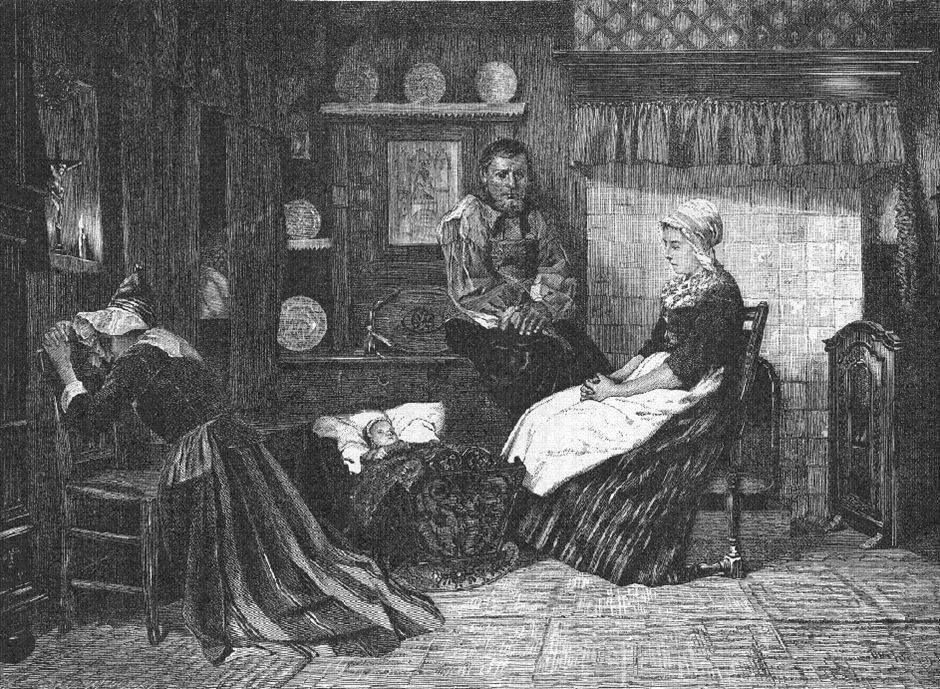
[Eigen Haard 1886]
Has Maria ever been happy? She must have been, just after the birth of her first child, but what about later on? Maria’s misfortunes were no exception at the time. The poor and the rich (and Maria among them) had to endure similar trials.
How did people manage to live in those harsh demographic conditions? A possible answer lies in the role of faith. In the 17th, 18th and early 19th centuries, most people still believed in an afterlife. Strictly speaking, death would be a release from misery, perhaps even a reason for celebration: the child (or father, mother, brother or sister) was in heaven, near God, the best place you could wish for. Was this how life and death could be accepted? If so, we should be able to find some evidence from the preserved diaries, letters and memoirs that reflect the everyday life of those days.
Celebrating Death?
The experience of death as a happy event (because death meant the end of misery and the beginning of heavenly bliss) can be seen most clearly in a story written by Jan Backer in 1797. He travelled through the Netherlands and wrote a comprehensive account about the tour. The father of a good friend died when Backer went to Leyden University. The whole family were very sad, but his friend never wept. On the contrary, he was cheerful and tried to comfort his brothers and sisters. “I was sad,” he said, “because I saw the good old man struggle and suffer. I wished I could in his place, but now, now he is blessed, and we should be happy because his sufferings are over and he is in heaven. If we really believe in God we must be joyful today.”
Cakes and Ale
A second example is taken from the memoirs of Keetje Hooijer whose father and husband were both pastors. She tells a story about the Rotterdam merchant Ledeboer (1764-1848) who did not feel it was necessary to make so much of the death of his two adult sons around 1830. He said his children had not ‘passed away’ but had ‘passed on’ to heaven. Keetje: “These considerations were to him no hollow phrases, as they are to so many people, but full of truth and they supported him in his losses so much so that it seemed a form of harshness.”
In 1837, when he had been married for 50 years, Ledeboer had a big pie made in the form of a sarcophagus with the names of his deceased sons on it. According to him they should be commemorated at the party. His housemates tried to persuade the baker not to carry out the order, but he refused to do so. The pie arrived, but some of those present tried to get it out of sight in the corner of the very large table.

“Do Not Comfort Us.”
We also find exceptionally strong emphasis on the consolation of faith in the memoirs of Zschokke. He was a Swiss administrator and author of a Daily Devotional. In the middle of the 19th century he looked back on his life, in which he had sustained much grief: four of his twelve children had already died. He had experienced much sadness, but he knew that his children were in heaven. Zschokke: “Death is something festive and important like everything that comes to us from God. The death of my children sanctifies me; pulls me more and more away from the alluring tricks of earthly life, to the divine, cleanses my feelings and thoughts.”
In this way you are reminded of what life should really be about. Zschokke continues: “Do not comfort us. We weep, because we are children of this world; but in spirit we are comforted and happy, because we know to Whom we and our loved ones belong.” As Zschokke wrote this at the end of his life, we may assume that he could write in this way because his sorrow had been somewhat mitigated over time. Besides, since he also mentions ‘weeping’, the funerals of his children had not been very joyful occasions, to say the least.
In the End There Were Tears
In the past few centuries not so many people experienced the death of their loved ones in a joyful spirit, even if they felt death had been overcome by faith. We must conclude that in this respect Ledeboer and Jan Backer’s friend were exceptions.
We began this essay describing a son who felt happy after the death of his father. We end in a minor key: a son who is very sad after his mother’s death. On Sunday-morning October 19, 1717, Samuel Sewall’s wife died in Boston after having been married for 41 years. In the afternoon Samuel went to church as usual. He had written a note to announce the death of his wife. His son, the officiating minister, led the service and had to read out the note to the congregation. Sewall wrote in his diary: “My son has much adoe to read the note I put up, being overwhelm’d with tears.”
Sources: J.A. Backer, De jonge reiziger door Nederland, deel 2 (Amsterdam 1797); H. Zschokke, Mijn leven, denken en werken (1854, orig. 1848); The Diary of Samuel Sewall (2 vols. 1973); Keetje Hooier-Bruins, Domineesdochter in ’s Graveland (1981, orig. 1884); J.H. Scheffer, “Het dagboek van een merkwaardige vrouw”, Algemeen Nederlandsch Familieblad 1 (1883/1884).
Translated by Ite Wierenga
